INTERACT must be switch into Observation Mode before it can log your Events.
Observation Mode
To start the actual logging process, you need to activate INTERACT's Observation Mode:
▪Make sure the required Coding Mode is selected, and your source of observation is available.
▪To activate the Observation Mode, click  .
.
A new file is automatically created, if no data-file was open yet.
If you have already opened one or more multimedia files (the moment a new data-file is created) a dialog, asking you if you want to link your multimedia to the new data-file, appears:
 | No: Nothing happens and you can proceed without linking your multimedia files. |
| Yes: A dialog, on where you plan to save your data, appears: |
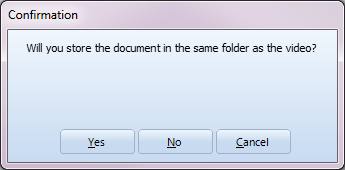
What answer is best for you, depends on local your file & folder policies (or the network- and external drives structure).
If possible, store the INTERACT data-file within the same folder as the source material. In that case, you can use the relative reference (find files inside the same folder), which allows you to re-locate, re-organize, rename and copy your folders, without losing the file reference.
If you do not have writing access to video storage drive, you'll need to use the absolute reference.
This is how INTERACT responds to your choice:
| No - INTERACT creates an absolute reference by entering the full name and path of the open multimedia files(s) into the transcript field of either the superordinate DataSet, including the current offset in milliseconds - if available, like this: |
Video: "F:\INTERACT_UserData2\Multimedia\MangoldSolutions.avi", OffsetMs:2500
It is important that you do not rename the video or any of the path items, otherwise INTERACT is not able to locate the file(s). If you store your videos on an external hard disc or file server, it is important that the disc is mounted under the same drive letter (F: in this example), otherwise INTERACT cannot find the video!
(In unsaved documents only full references work.)
| Yes - INTERACT enters only the name of the multimedia file(s), including any the time offset information - if available - like this: |
Video: "MangoldSolutions.avi", OffsetMs:2500
With such a relative reference, the file reference stays valid, for as long as the *.xiact file and linked multimedia file(s) are stored within the same folder.
| Cancel - No reference is entered. |
Semi-Absolute References
If you have multiple videos per scene, saving all the videos and files in a single folder tends to be confusing.
That is why you can create separate 'video folders' within a single 'study folder' to organize your videos in a structured way. You can then put all INTERACT documents together in the top level of your "Study" folder, as follows:
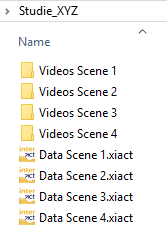
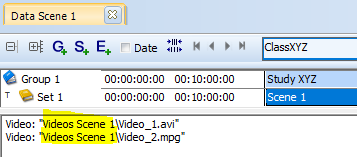
This allows you to insert at least drive letter independent references to your videos:
Additionally, the button you clicked to start your session, changes to  and the the Active Codes field appears in the toolbar.
Last but not least, the Coding panel appears, enabling you to log Events with your mouse:
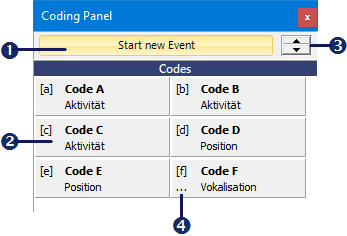
INTERACT is now in Observation mode and ready to log whatever Codes you have defined.
▪According the selected Coding Mode, you can now use your Codes to manually Log Events.
Session Structure
Per default, INTERACT creates a DataGroup and DataSet, whenever your start an observational session, within a new empty document. Typically, each DataSet holds all observations per test situation.
For multiple sessions within one data-file, you need to add a DataSet for each session manually.
IMPORTANT: Log Events -that belong to the same observed situation- into the same data-file, and in most cases, even inside the same DataSet. Even if you use different Code definitions and multiple passes to collect the data!
| TIP: | During the observation stage, create a new data-file for each video, just to prevent accidentally damaging previous observations. Before you start with the Analysis, use the applicable Merge data-files routine. |
Add DataSet for new Session
To manually add a DataSet:
▪Click Insert - Elements - Add DataSet  in the INTERACT toolbar or use the corresponding little icon in front of the Class column headers.
INTERACT creates a new line within the selected DataGroup.
If no DataGroup is available yet, INTERACT automatically creates a DataGroup as well.

▪Enter a descriptive title into the empty 'Set' line; this description also appears in DataSet based statistics!
| TIP: | Further details about structuring your data-file, can be found in the section Structure Logged Events. |